Portland, Oregon | Advisor: Raymond Meeks
Will Matsuda (b. 1993) is a Japanese American photographer and writer focusing on his culture, his family, and the environment. His work has appeared in The New York Times, National Geographic, and The New Yorker, among many other publications. A photograph from his series Hanafuda appeared on the cover of the Spring 2022 issue of Aperture magazine. His works have been exhibited internationally by Aperture Foundation and Yancey Richardson Gallery. He splits time between New York City and Portland, Oregon, where he was born.
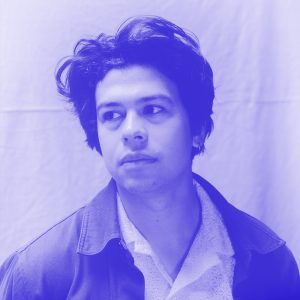
“The program, along with my advisor, Raymond Meeks, pushed me into the most generative and expansive period of my artistic career so far.”
– Will Matsuda | ’25 Senior Fellow
Project Statement
This project, One Thing Against Another Creates, revolves around my family’s relationship with the atomic bombing of Hiroshima. Many of my family members died that day. There is a famous picture of a man’s shadow fixed into the concrete near where the bomb exploded. The bomb was a photographic event, turning the city into a giant cameraless image due to the intensity of the heat and light. John Hersey’s book about the bomb and its aftermath, Hiroshima (1946), tells how the bomb burned the city’s shadows into the walls of buildings, sidewalks, and even people’s skin.
As a photographer with direct connections to the atomic bombing of Hiroshima, I am reappropriating a similar cameraless photographic process. Using light, shadow, and a photosensitive surface (color darkroom paper), I am walking around the city at night and making exposures of life, beauty, and resilience, rather than death, while still connecting to the history of the bomb.
I exposed the darkroom paper directly to objects that survived the bomb and their shadows: a charred and partially-melted teapot at the Hiroshima Peace Memorial Museum, the branches of a willow tree that is the closest still-living tree to the epicenter, a paper lantern at a shrine in my great-great grandmother’s neighborhood. Because the paper is so light-sensitive, I could only make these images at night, in the dark. During the days, I photographed the memorials and the way visitors moved through them. I photographed the neighborhoods where my family lived.
In his 1933 essay on Japanese aesthetics, “In Praise of Shadows,” Jun’ichiro Tanizaki writes: “We find beauty not in the thing itself, but in the patterns of shadows, the light and darkness, that one thing against another creates.” The title of this project comes from this line, which has been an instinctual guide. Beauty and creation arise out of light, shadow, and the surface upon which they fall. Tanizaki is describing photography–a way of seeing, with or without a camera.
2025 Senior Fellows: Michelle Arcila | Will Matsuda | José Ibarra Rizo